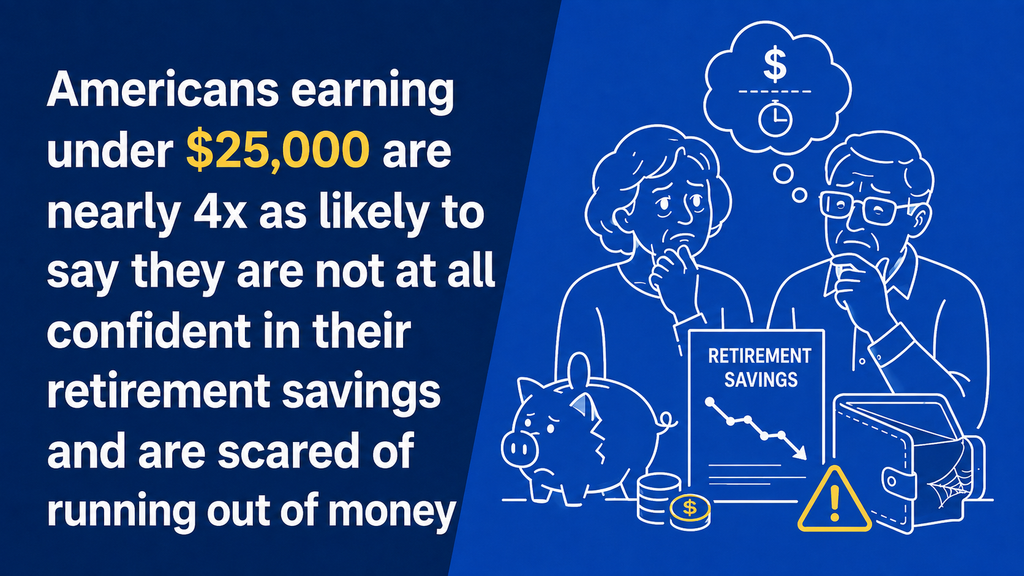
The sharpest retirement fear in America belongs to the people with the least. Americans earning under $25,000 are nearly 4x as likely as six-figure earners to say they are scared of running out of retirement money. The pattern follows income far more closely than age, which upends the usual assumption that fear rises as retirement nears.
There is a harder edge to it. The people most frightened of outliving their savings are also the least willing to look at the products built to prevent that outcome. Among Americans already saving for retirement, 40.5% say they would eagerly explore a guaranteed monthly paycheck. Among those not saving and worried about affording life later, only 23.3% say the same.
That anxiety is surfacing at a moment when the retirement system itself is being second-guessed. Only about 14% of private-sector workers still have access to a traditional pension, per the Bureau of Labor Statistics, and confidence in the 401(k) era is thin. A new survey of 1,000 U.S. adults, fielded for retirement-income specialist John Stevenson, maps where the fear concentrates, who gets blamed for it, and what, if anything, would move people to act.
Key Findings
- Americans earning under $25,000 are nearly 4x as likely as those earning $100,000 to $249,999 to say they are scared of running out of retirement money, 28.4% against 7.4%.
- Among current savers, 40.5% would eagerly explore a guaranteed monthly paycheck, compared with just 23.3% of non-savers who worry about the future.
- Just 21.3% of Americans say the 401(k) has given people more control and opportunity, while 41.7% say it works better for higher earners.
- 46.1% say reviving traditional pensions would improve retirement security outright; another 40.4% would support it only if workers keep some control over their savings.
- 36.4% of Gen Z and 37.1% of Baby Boomers would choose a guaranteed monthly paycheck for life, versus 26.2% of Gen X.
- 46.5% of Gen Z blame the government for the pension’s decline, ahead of every other generation.
Retirement Fear Concentrates Among the Lowest Earners
Confidence about retirement is usually framed as a matter of age. The closer you get, the more settled you should feel. This data points somewhere else.
Americans earning under $25,000 are nearly 4x as likely to say they are not at all confident in their retirement savings and are scared of running out of money. 28.4% of the lowest earners say so, against 7.4% of those earning $100,000 to $249,999. The fear clusters at the bottom of the earnings range, and it tracks income more tightly than it tracks how old someone is.
Fear is the human center of this survey. It sits with the people who have the least room to absorb a bad year, which is what raises the stakes for everything that follows.
Only One in Five Americans Say the 401(k) Actually Worked
The 401(k) was supposed to hand workers the keys. Choose your contributions, pick your funds, watch the balance grow. Four decades on, most people are not sold.
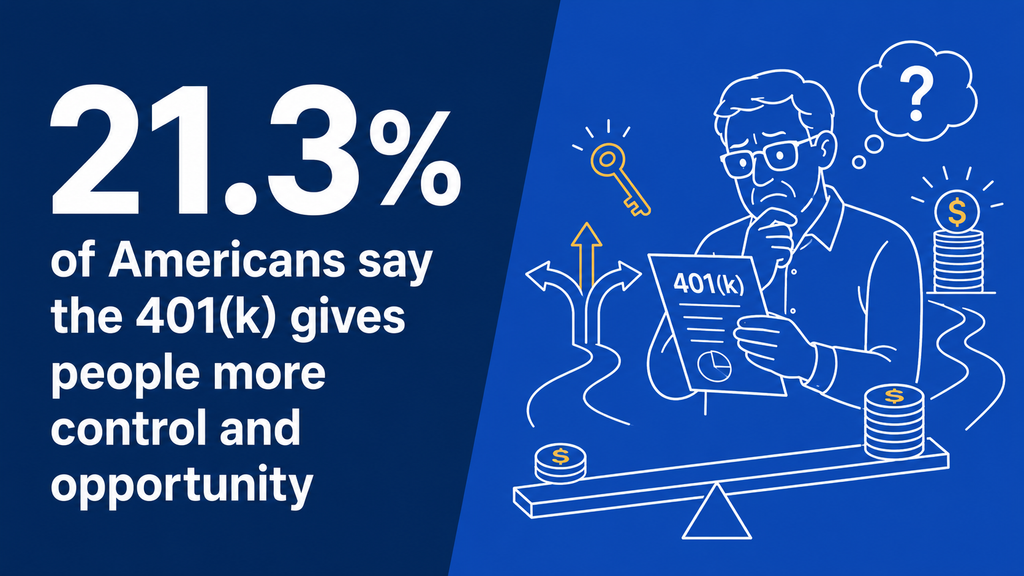
Just 21.3% of Americans say the 401(k) gives people more control and opportunity. The plurality view, held by 41.7%, is that it works better for higher earners. The finding that lands hardest is who agrees with it.
Agreement that the system favors higher earners climbs with income: 37.7% of the lowest earners say so, rising to about 44% among households earning between $50,000 and $249,999. The workers best positioned to do well under the current setup are among the readiest to say it tilts their way.
A retirement system that its own winners describe as uneven leaves plenty of room for people to wonder what the previous model offered.
Support for Bringing Pensions Back Spans the Income Ladder
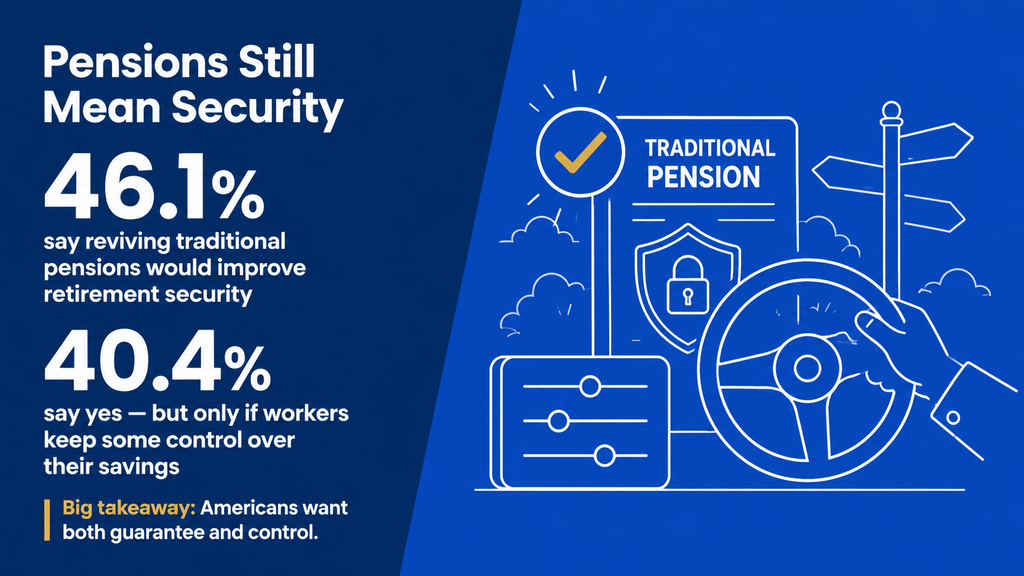
What the previous model offered, in most people’s memory, was certainty. Asked whether reviving traditional pensions would improve retirement security, 46.1% say yes outright. Another 40.4% say yes, but only if workers keep some control over their own savings. Presented separately, those two numbers tell a more precise story than a single combined figure: broad support for the guarantee, with a large share unwilling to give up all control to get it.
The support reaches well up the income ladder. Among those earning $100,000 to $249,999, 49.0% say pensions would improve security outright, with another 41.6% backing the idea as long as workers keep some control. Pension support reads less like a low-income worry and more like a widely shared one.
The conditional half of that number is the signal for anyone building the next generation of retirement products. People want the floor a pension provides without surrendering the control a 401(k) gave them.
Gen Z and Boomers Lean Toward a Guaranteed Check, Gen X Least of All
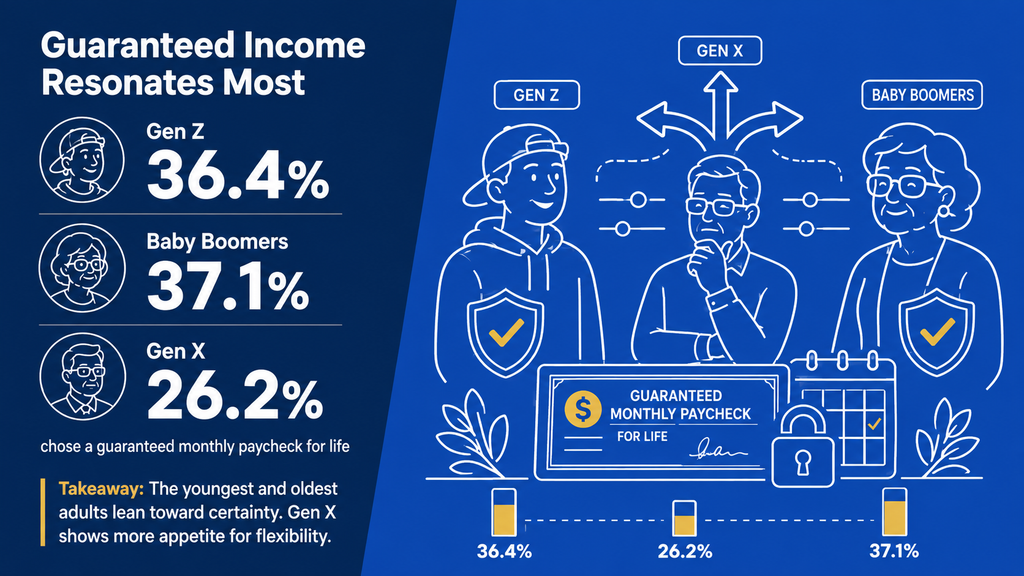
Broad support for pensions in the abstract does not resolve into agreement about what people actually want. Offered a choice among a guaranteed monthly paycheck for life, a lump sum, a hybrid, or a flexible option tied to market risk, respondents scattered. No single option commanded a majority, and the split by age did not run in a straight line.
36.4% of Gen Z and 37.1% of Baby Boomers chose the guaranteed monthly paycheck, the two highest shares in the study. Gen X came in lowest at 26.2%. The generations at the start and the end of their working lives gravitate toward certainty, while the one in the middle, still building wealth and carrying peak expenses, shows more appetite for flexibility.
The practical read for plan sponsors is that demand for guaranteed income does not sit in one age bracket. It shows up at both ends of the working span at once.
The Generations Split on Who Killed the Pension
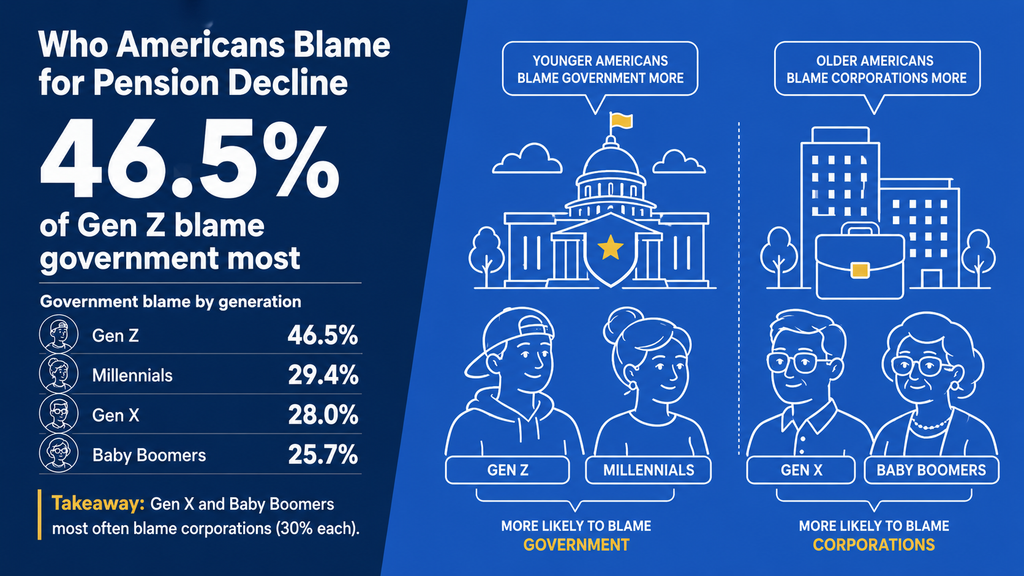
Someone let the pension slip away. Americans do not agree on who.
Gen Z blames the government far more heavily than any other generation. 46.5% name the government failing to protect pension access as the main reason pensions declined, against 29.4% of Millennials, 28.0% of Gen X, and 25.7% of Baby Boomers. Government tops the list for both younger generations, Gen Z and Millennials, though Gen Z holds it responsible at a far higher rate. Gen X and Baby Boomers put the blame elsewhere, with corporations topping their lists at 30% each.
The result is a generational fault line. The younger half of the workforce points at Washington, the older half at the private sector. The survey records where each generation assigns responsibility, not why, but a divide that sorts this neatly by age is the kind of detail policy reporters notice.
Most Would Explore Guaranteed Income, If Shown the Numbers
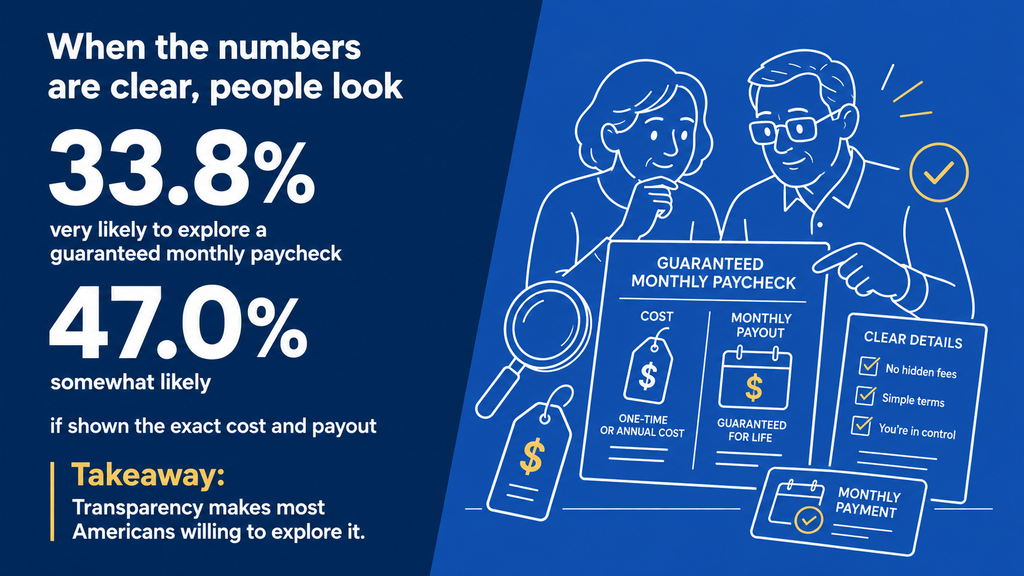
Here is where the fear at the top of this piece meets the market’s response to it.
The industry is moving fast. U.S. annuity sales hit a record $464.1 billion in 2025, according to LIMRA, and firms including BlackRock, Vanguard, and Fidelity are now embedding guaranteed-income features into the target-date funds that sit at the center of millions of 401(k)s. The supply of paycheck-for-life products is expanding into exactly the accounts most Americans already use.
The demand is real, and it turns on transparency. 33.8% of Americans say they would be very likely to explore a guaranteed monthly paycheck if shown exactly what it would cost and what it would pay, and another 47.0% say somewhat likely. Put a clear price and payout in front of people and most will at least look.
The catch is the one the survey opened on. The savers most eager to explore are the ones already saving, 40.5% of them very likely to look. The people not saving, the ones who told this survey they are scared of running out, come in at 23.3%. The product the industry is racing to build reaches softest into the group with the least margin for error. Closing that distance is less about the size of the guarantee than about who ever gets shown the numbers.
Summary
The retirement story most Americans tell is a story about certainty, who has it, who lost it, and who is most afraid of never getting it back. This survey locates that fear precisely. It sits with the lowest earners, not the oldest savers, and it sits alongside a quiet reluctance to look at the very tools designed to relieve it.
Guaranteed income is returning, not as the pension of the past but as something folded into the plans people already hold. Whether it reaches the savers who need it most will depend less on the size of the paycheck it promises and more on whether anyone puts the real numbers in front of them. The appetite is there once people can see the tradeoff plainly. The work left undone is making sure the people most afraid are the ones who get to see it.
Methodology
To understand how Americans approach retirement security and guaranteed income, we surveyed 1,000 U.S. adults across the country in July 2026 through Pollfish, an online survey platform. Participants answered questions about their views on traditional pensions and 401(k) plans, their confidence in their own retirement savings, the tradeoffs they would accept between guaranteed income and flexibility, and what would make them comfortable exploring a guaranteed monthly paycheck. Responses were analyzed by demographic groups, including age, gender, household income, and education level, to identify trends and disparities.
Fair Use Policy
Users are welcome to utilize the insights and findings from this study for noncommercial purposes, such as academic research, educational presentations, and personal reference. When referencing or citing this article, please ensure proper attribution to maintain the integrity of the research. Direct linking to this article is permissible, and access to the original source of information is encouraged.
For commercial use or publication purposes, including but not limited to media outlets, websites, and promotional materials, please contact the authors for permission and licensing details. We appreciate your respect for intellectual property rights and adherence to ethical citation practices. Thank you for your interest in our research.